
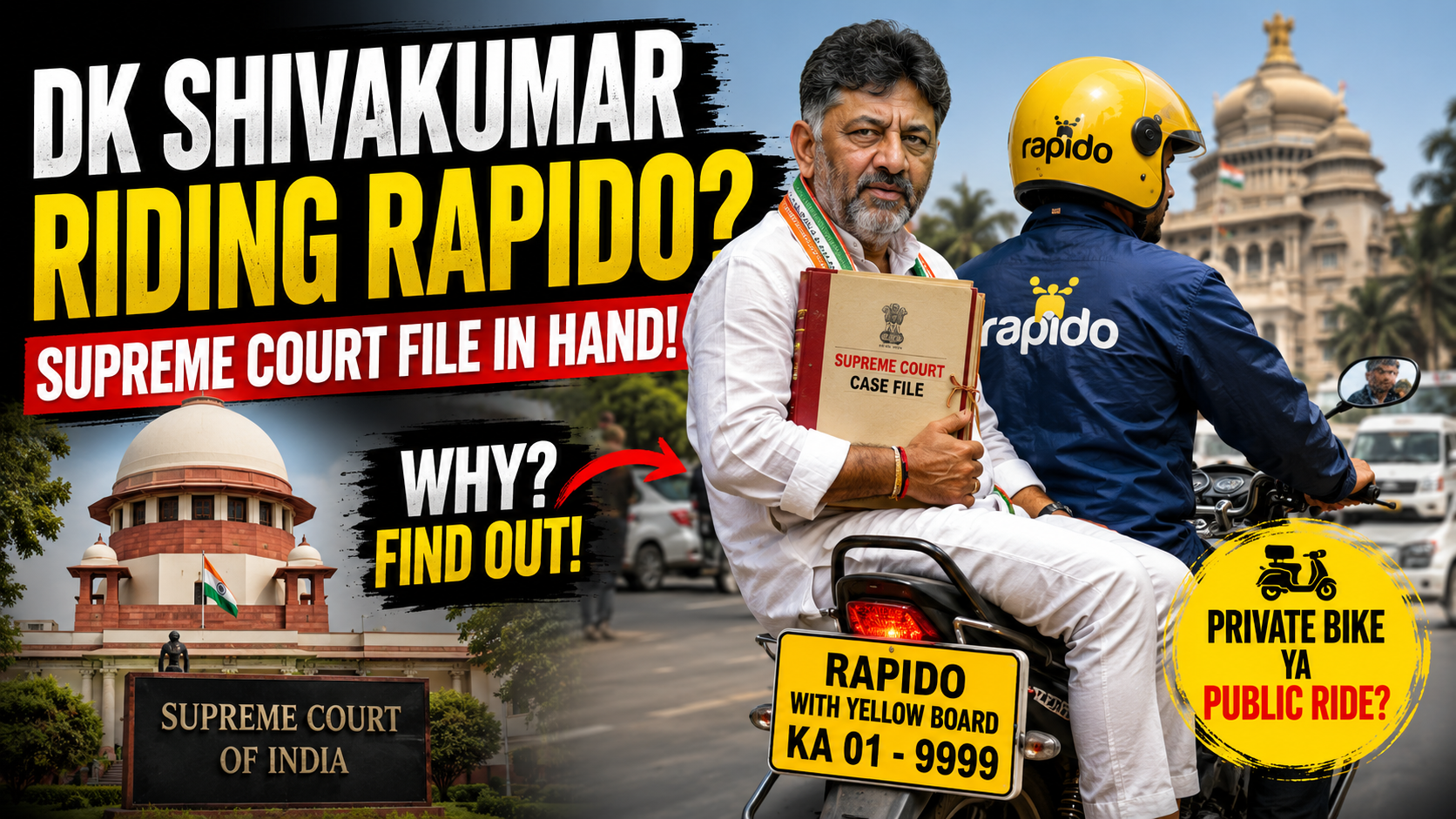
The Yellow Plate Paradox: Why Bengaluru’s Gig Economy Is Trapped in Legal Limbo and How We Fix It
By Farhan Rasheed
A True Guide Real Estate Research Advisor & Public Interest Commentator
Introduction: The Sound of the Siren on 100 Feet Road
If you stand at the Junction of 100 Feet Road in Indiranagar on any given weekday afternoon, you will witness a microcosm of urban mobility. Hundreds of young men and women—riding commuter two-wheelers—weave through gridlocked traffic to deliver commuters to the nearest Namma Metro station, fetch groceries, or transport tech professionals to ITPL.
Yet, every few hundred meters, a scene unfolds with alarming regularity: a Transport Department enforcement team or traffic police officer flags down a two-wheeler, demands the vehicle’s Registration Certificate (RC), and issues a heavy challan or seizes the bike. The reason? The vehicle carries a standard white number plate (private registration) while performing a commercial ride-hailing task.
The immediate reaction from the government is clear: “You are operating illegally. Under the Motor Vehicles Act, 1988, any vehicle carrying passengers or goods for commercial hire must display a yellow number plate.”
The rider’s response, however, is equally straightforward and desperate: “Sir, show me where to apply for a yellow number plate for my 125cc bike. Show me the portal. Show me the RTO window. I am ready to pay the tax. I am ready to buy commercial insurance. Just give me the path to legitimacy!”
And there lies the core contradiction currently paralysing Bengaluru’s transit ecosystem.
As of August 2026, Karnataka finds itself locked in a legal and administrative stalemate. On one side, the Division Bench of the Karnataka High Court ruled that denying contract carriage permits to two-wheelers is an unreasonable restriction on trade, directing the State to register motorcycles as transport vehicles with yellow number plates. On the other side, the State Government has challenged this ruling in the Supreme Court, while launching statewide enforcement drives—seizing over 250 bike taxis in Bengaluru alone in recent weeks.
This open letter and structural breakdown addresses Deputy Chief Minister Shri D.K. Shivakumar Ji and the Karnataka State Transport Department. It lays out the exact operational mechanisms, legal loopholes, and economic realities of converting private two-wheelers to yellow-board commercial transport, while providing a clear roadmap to resolve this crisis once and for all.
1. The Legal Reality: White Board vs. Yellow Board
To understand why thousands of bike taxi riders find themselves at risk of vehicle impoundment, we must examine the legal frameworks governing India’s roads.
       +-------------------------------------------------------------------+
       |                       MOTOR VEHICLES ACT, 1988                     |
       +---------------------------------+---------------------------------+
                                         |
                +------------------------+------------------------+
                |                                                 |
                v                                                 v
  +---------------------------+                     +---------------------------+
  |    PRIVATE VEHICLES       |                     |    COMMERCIAL VEHICLES    |
  |     (White Plate)         |                     |      (Yellow Plate)       |
  +---------------------------+                     +---------------------------+
  | * Non-Transport Category  |                     | * Transport Category      |
  | * Personal commuting      |                     | * Contract / Stage        |
  | * One-time Life Tax paid  |                     |   Carriage Permits        |
  | * Standard Insurance      |                     | * Periodic Commercial Tax |
  | * NO commercial hire      |                     | * Commercial Passenger    |
  |                           |                     |   Third-Party Insurance   |
  +---------------------------+                     +---------------------------+
The Motor Vehicles Act, 1988
Under the Motor Vehicles Act, 1988, motor vehicles are broadly categorized into two structural classes:
- Non-Transport Vehicles (Private Class): Displaying white backgrounds with black lettering (or green with white lettering for private Electric Vehicles). These are registered for personal use. The owner pays a one-time lifetime road tax upon registration. The law strictly prohibits using a non-transport vehicle to carry fare-paying passengers or commercial cargo.
- Transport Vehicles (Commercial Class): Displaying yellow backgrounds with black lettering (or green with yellow lettering for commercial Electric Vehicles). These are licensed to operate as “Contract Carriages” or “Stage Carriages.” They are subject to periodic road taxes, strict fitness testing (FC), commercial third-party insurance mandates, and compliance with statutory permit conditions under Section 74 of the Act.
The Conflict
When a gig worker mounts a smartphone on their handlebars and accepts a passenger ride via an app-based aggregator, the vehicle transitions instantly from personal transportation to a commercial enterprise.
When enforcement officers impound these vehicles, they are enforcing the letter of the law: a private white-plate vehicle cannot perform commercial contract carriage duty.
However, the legal argument breaks down at the next step. When a rider walks into a Regional Transport Office (RTO) in Kasturi Nagar, Rajajinagar, or Electronic City and asks to register or convert their motorcycle into a commercial transport vehicle (yellow board), the RTO officers turn them away.
Why? Because the State machinery lacks a clear statutory mechanism and notified policy to issue contract carriage permits to two-wheelers.
2. Step-by-Step Breakdown: How White-to-Yellow Conversion Works
To illustrate the procedural challenge, let us review the standard national procedure required by the Ministry of Road Transport and Highways (MoRTH) to convert a vehicle from private (white plate) to commercial (yellow plate) status, and see where it hits a roadblock for two-wheelers in Karnataka.
+-----------------------------------------------------------------------------------+
|                  STANDARD RTO VEHICLE ALTERATION WORKFLOW                         |
+-----------------------------------------------------------------------------------+
                                         |
                                         v
   +---------------------------------------------------------------------------+
   | STEP 1: Hypothecation Removal / No Objection Certificate (NOC)             |
   | Clear outstanding loans with financier; obtain Form 35 & NOC.             |
   +---------------------------------------------------------------------------+
                                         |
                                         v
   +---------------------------------------------------------------------------+
   | STEP 2: RTO Application & Category Re-classification                      |
   | Submit Form 20 & Form 30 at local RTO; pay category re-classification fee. |
   +---------------------------------------------------------------------------+
                                         |
                                         v
   +---------------------------------------------------------------------------+
   | STEP 3: Commercial Insurance & Fitness Inspection                         |
   | Cancel private policy; issue Commercial Passenger Insurance.              |
   | Present vehicle for physical RTO inspection & Fitness Certificate (FC).   |
   +---------------------------------------------------------------------------+
                                         |
                                         v
   +---------------------------------------------------------------------------+
   | STEP 4: Differential Tax Calculation & Payment                            |
   | Convert one-time life tax to commercial tax schedule; pay differential.   |
   +---------------------------------------------------------------------------+
                                         |
                                         v
   +---------------------------------------------------------------------------+
   | STEP 5: Contract Carriage Permit Issuance & Yellow HSRP                   |
   | Secure Section 74 Permit; install Yellow High-Security Registration Plate. |
   +---------------------------------------------------------------------------+
Step 1: Hypothecation Clearance and NOC
If the vehicle was purchased via an auto loan (as over 70% of commuter two-wheelers in India are), the owner cannot alter the vehicle category without the explicit consent of the financing bank or NBFC.
- Requirements: Pay off the loan balance or secure a formal No Objection Certificate (NOC) for commercial conversion from the lender.
- Documentation: Form 35 (Termination of Hypothecation) filed with the local RTO.
Step 2: Application for Category Alteration at the RTO
The registered owner submits an application to the jurisdictional RTO to alter the vehicle class from “Motorcycle for Personal Use” to “Motorcycle – Transport/Contract Carriage.”
- Forms Required:
- Form 20: Application for Registration of a Motor Vehicle.
- Form 29 & 30: If ownership is being transferred to a commercial entity.
- Original Registration Certificate (RC Book / Smart Card).
- Valid Pollution Under Control (PUC) Certificate.
- Address and Identity Proofs (Aadhaar, PAN).
Step 3: Commercial Passenger Insurance Policy Transition
Private vehicle insurance policies explicitly contain a Limitation as to Use Clause, which states: “The policy does not cover use for hire or reward.” If a white-plate rider carrying a passenger suffers an accident, the insurance company will reject the claim.
- Conversion Action: The owner must cancel the private comprehensive policy and purchase a Commercial Transport Vehicle Insurance Policy, which includes passenger liability cover, driver personal accident cover, and elevated third-party property damage coverage.
Step 4: Tax Differential Adjustment and Fitness Certification
Commercial vehicles do not operate on the standard private lifetime tax scale.
- Taxation: The RTO must calculate the differential road tax.
- Fitness Inspection: The two-wheeler must undergo a manual physical inspection by an RTO Inspector of Motor Vehicles (IMV) to secure a Fitness Certificate (FC), ensuring structural integrity, commercial braking efficiency, and roadworthiness.
Step 5: Application for Permit under Section 74 and HSRP Allocation
This is the final requirement. Once the RTO approves the reclassification, the owner receives a Contract Carriage Permit.
- Finalizing Conversion: With the permit approved, the Parivahan database updates the vehicle status to “Transport.” The owner can then order an official High-Security Registration Plate (HSRP) featuring a yellow background with black lettering (or green with yellow lettering for EVs).
The Catch-22 in Karnataka
If the workflow outlined above exists in national motor vehicle frameworks, why can’t a rider in Bengaluru complete it today?
Here is the operational bottleneck: RTO officers cannot issue a permit (Step 5) for a specific vehicle category unless the State Government officially notifies the regulatory rules and permit parameters for that category.
When a rider submits Form 20 to convert a 110cc scooter to a transport vehicle, the RTO software system rejects the entry because the Karnataka State Transport Department has not activated the “Motorcycle Contract Carriage Permit” portal options following the withdrawal of the 2021 Electric Bike Taxi Scheme.
This creates a Catch-22:
- The Police seize the bike because it lacks a yellow plate.
- The RTO refuses to issue a yellow plate because the State hasn’t opened the registration system.
- The Aggregators continue operating via app dispatch because demand remains high.
- The Rider bears the entire financial and legal risk.
3. Direct Questions to Deputy CM Shri D.K. Shivakumar Ji
Shri D.K. Shivakumar Ji, as a leader who regularly emphasizes Bengaluru’s position as a global technology capital, a hub of innovation, and a model for infrastructure growth, this policy gap requires your immediate attention.
       +-------------------------------------------------------------------+
       |                 THE POLICY GAP: FOUR CRITICAL QUESTIONS            |
       +-------------------------------------------------------------------+

       [1. WHERE IS THE RTO WINDOW?]
       "If operating on a white board is illegal, where is the statutory
        form or RTO portal window to convert to a yellow board?"

       [2. WHY DENY REGULATION WHEN DEMAND IS 2.3 LAKH RIDES/DAY?]
       "If Goa has permitted yellow-board bike taxis since 1981, why is
        Bengaluru penalizing a system that serves 230,000 daily commuters?"

       [3. WHY TARGET GIG WORKERS WHILE AUTO METER VIOLATION GOES UNCHECKED?]
       "Why are two-wheelers impounded for lack of permits while auto-rickshaws
        routinely refuse meters and demand ₹200 for 3km trips?"

       [4. WHAT IS THE COMPREHENSIVE ROADMAP?]
       "Will the State establish a clear regulatory framework—combining
        Geo-fencing, mandatory insurance, and yellow plates—or rely on bans?"
Question 1: Where is the Application Portal?
If the State’s official position before the Supreme Court and in daily traffic drives is that white-plate two-wheelers cannot operate commercially, where is the clear, functional gateway for a willing citizen to apply for a yellow plate?
If a young unemployed graduate in North Bengaluru buys a two-wheeler and wants to pay commercial tax, buy commercial insurance, and affix a yellow board to earn a living, which RTO counter should they visit? Why has the Transport Department not released a clear procedure for individual vehicle conversions?
Question 2: Why Ignore the Reality of 2,30,000 Daily Rides?
Data from transit analytics shows that Bengaluru records between 2,00,000 and 2,30,000 bike taxi rides every single day. These are not luxury journeys; they are first-and-last-mile connections for software engineers, retail workers, factory staff, and students commuting to Metro stations and bus terminals.
Goa legalized yellow-board two-wheeler taxis (Pilots) as far back as 1981 under statutory state amendments, catering successfully to roughly 18,000 to 20,000 daily rides. If a smaller state built a functional framework four decades ago, why is Karnataka—the Silicon Valley of Asia—struggling to integrate a transport mode that millions of its citizens rely on?
Question 3: Why the Selective Enforcement Asymmetry?
Why is enforcement focused almost exclusively on bike-taxi gig workers while widespread violations by auto-rickshaw operators go unaddressed?
Every day across Bengaluru, commuters face auto-rickshaw drivers who decline rides, refuse to run standard meters, and demand arbitrary fares—often ₹150 to ₹200 for short 3-kilometer trips. Yet, we rarely see massive, multi-day enforcement drives impounding thousands of non-compliant auto-rickshaws. Why is the state’s enforcement apparatus directed at young workers providing ₹40 to ₹60 rides, while commuters struggle with exorbitant last-mile fares?
Question 4: Is Political Expediency Blocking Modern Transit Policy?
Is the delay in formulating a comprehensive, yellow-board bike taxi policy driven by genuine safety concerns, or by pressure from traditional transport unions fearful of market competition?
Leadership requires balancing the interests of traditional transport unions with the needs of 1.3 crore city residents who require affordable, efficient transportation options.
4. Economic Impact Analysis: Commuters, Gig Workers, and the State Exchequers
To evaluate the broader implications of bike taxis, we must examine their economic impact across three distinct groups: the commuter, the gig worker, and the state government.
+-----------------------------------------------------------------------------------+
|                           TRIP ECONOMICS COMPARISON                               |
|                     (Standard 4-Kilometer Peak-Hour Transit)                      |
+-----------------------------------------------------------------------------------+
|  MODE             | AVERAGE COST  | DURATION  | COMMUTER SURPLUS / VALUE      |
+-------------------+---------------+-----------+-----------------------------------+
| Auto-Rickshaw     | ₹150 - ₹200   | 25-35 min | Low (High cost, meter refusal)    |
| (Flat Demand)     |               |           |                                   |
+-------------------+---------------+-----------+-----------------------------------+
| Bike Taxi         | ₹45 - ₹65     | 12-18 min | High (Affordable, cuts traffic)   |
| (App-Based)       |               |           |                                   |
+-------------------+---------------+-----------+-----------------------------------+
| Economic Impact:  | Bike taxis save the average commuter ₹100-₹130 per trip and    |
|                   | reduce travel time by up to 50% in dense corridors.           |
+-----------------------------------------------------------------------------------+
The Commuter’s Dilemma
Consider an early-career employee living in Whitefield who earns ₹25,000 per month.
If forced to pay ₹150 each way for an auto-rickshaw ride between their apartment and the nearest Metro station, their daily commuting expense reaches ₹300. Over 22 working days, that totals ₹6,600 per month—over 26% of their take-home income spent purely on last-mile connectivity.
A bike taxi for the same distance costs approximately ₹45 to ₹55. This brings the monthly commute expense down to ₹2,200, freeing up ₹4,400 per month in disposable income. Multiplying this across 2,00,000 daily users shows how affordable micro-mobility directly supports the local economy.
The Gig Worker’s Livelihood
For the rider, operating a bike taxi is often a primary source of household income or a crucial buffer during employment transitions.
- Average Daily Gross Earnings: ₹800 to ₹1,200 (for 10-12 completed rides).
- Fuel & Maintenance Costs: ₹250 to ₹350.
- Net Daily Income: ₹550 to ₹850.
When the Transport Department seizes a worker’s bike, the impact goes beyond a simple fine:
- The rider faces a court/RTO penalty often ranging from ₹5,000 to ₹10,000.
- Their vehicle remains impounded for 30 days or more.
- Their primary income stream drops to zero overnight, while fixed costs like bike EMIs and personal living expenses continue to accumulate.
The State Treasury’s Lost Revenue
By leaving bike taxis in regulatory limbo, the Karnataka State Treasury forfeits significant tax revenue:
- Commercial Conversion Fees: Fees from converting 50,000 two-wheelers to commercial registration.
- Commercial Road Taxes: Quarterly or annual commercial transport taxes collected per vehicle.
- Permit Processing Revenue: Application fees for contract carriage permits under Section 74.
- GST Revenue: State share of GST on platform service fees collected by aggregators like Rapido, Uber, and Namma Yatri.
Instead of generating steady annual revenue through a transparent licensing system, the State spends public funds funding enforcement teams to seize vehicles and manage impound yards.
5. Comparative Study: The Goa Yellow Taxi Model (1981-Present)
When transport officials claim that two-wheelers are inherently unsuitable for commercial passenger transport, it is worth looking at the legal framework established in Goa over four decades ago.
+-----------------------------------------------------------------------------------+
|                        GOA MODEL VS. BENGALURU PRESENT STATUS                     |
+-----------------------------------------------------------------------------------+
| ATTRIBUTE          | GOA TWO-WHEELER TAXIS ("PILOTS") | BENGALURU BIKE TAXIS (2026)  |
+--------------------+----------------------------------+---------------------------+
| Legal Status       | Formally legalized in 1981       | Legal status contested    |
|                    | under State MV Rules             | in Supreme Court          |
+--------------------+----------------------------------+---------------------------+
| Registration Class | Commercial Yellow Board          | Predominantly White Board |
|                    | (Transport Category)             | due to policy freeze      |
+--------------------+----------------------------------+---------------------------+
| Operator Identity  | Badged "Pilots" with police      | Platform Gig Riders       |
|                    | background clearance             | with basic app check      |
+--------------------+----------------------------------+---------------------------+
| Daily Volume       | ~18,000 to 20,000 rides          | ~2,00,000 to 2,30,000     |
|                    | (Tourist & Local commuters)      | (Dense urban transit)     |
+--------------------+----------------------------------+---------------------------+
| Stand / System     | Designated town stands + apps    | Pure App-based dispatch   |
+--------------------+----------------------------------+---------------------------+
| Safety Record      | Integrated with state transport  | Unregulated enforcement   |
|                    | and local law enforcement        | friction                  |
+-----------------------------------------------------------------------------------+
In 1981, Goa amended its Motor Vehicles Rules to officially recognize motorcycle taxis, locally known as “Pilots.”
Key Elements of the Goa Framework:
- Commercial Two-Wheeler Class: Motorcycles were given a distinct commercial transport category with yellow plates.
- Operator Badging: Riders had to pass character verifications and earn an official “Pilot Badge” issued by the Transport Department.
- Dedicated Infrastructure: Municipalities provided designated stands for motorcycle taxis at bus terminals, market squares, and railway stations.
- Mandatory Passenger Safety Norms: Regulations required helmets for passengers and strict enforcement of speed-governor restrictions where necessary.
The Goa experience proves a simple point: When you formalize a transport sector, safety and accountability improve.
In contrast, trying to ban a transportation mode that has reached mass adoption simply pushes it into an unregulated shadow economy, exposing riders and passengers to greater risk.
6. The 5-Point Policy Blueprint: Resolving the Bengaluru Gridlock
To resolve the legal deadlock, protect gig worker livelihoods, and provide safe, affordable transport options for citizens, the Karnataka Government should consider a clear, five-step regulatory framework.
       +-------------------------------------------------------------------+
       |               THE 5-POINT REGULATORY ROADMAP                      |
       +-------------------------------------------------------------------+

       [1. NOTIFY SPECIAL COMMERCIAL TWO-WHEELER RULES]
       Create a formal "Motorcycle Contract Carriage Permit" under Sec 74.

       [2. OPEN A SINGLE-WINDOW DIGITAL CONVERSION PORTAL]
       Streamline white-to-yellow conversion via Seva Sindhu / Parivahan.

       [3. ENFORCE COMPREHENSIVE SAFETY & INSURANCE STANDARDS]
       Mandate commercial passenger coverage & dual helmets with Geo-fencing.

       [4. ESTABLISH AGGREGATOR ACCOUNTABILITY FRAMEWORKS]
       Require platforms to share API data and verify rider credentials.

       [5. INTEGRATE WITH NAMMA METRO & FIRST/LAST-MILE HUBS]
       Create formal bike-taxi pick-up/drop-off bays at major stations.
Point 1: Formally Notify “Motorcycle Contract Carriage Rules”
The State Transport Department should frame and officially notify updated Motorcycle Contract Carriage Rules under Section 74 of the Motor Vehicles Act, 1988.
This rule set should define the technical and operational criteria for commercial two-wheelers, including engine displacement limits (e.g., 100cc to 350cc), mandatory safety equipment, and age limits for operational vehicles (e.g., vehicles under 8 years old).
Point 2: Launch a Single-Window Digital Conversion Portal
Instead of forcing riders to navigate bureaucratic hurdles at physical RTO counters, launch an online single-window conversion portal integrated with Seva Sindhu and Parivahan.
+-----------------------------------------------------------------------------------+
|                        SINGLE-WINDOW CONVERSION PORTAL                            |
+-----------------------------------------------------------------------------------+
|                                                                                   |
|  [Rider Uploads: RC + Aadhaar + Commercial Insurance + DL]                        |
|                                     |                                             |
|                                     v                                             |
|  [Automated RTO Verification & Differential Tax Assessment]                       |
|                                     |                                             |
|                                     v                                             |
|  [Online Payment of Conversion Fees & Commercial Road Tax]                        |
|                                     |                                             |
|                                     v                                             |
|  [Digital Generation of Provisional Yellow-Board Contract Permit]                 |
|                                     |                                             |
|                                     v                                             |
|  [Authorized HSRP Vendor Issues Yellow Plates within 48 Hours]                    |
|                                                                                   |
+-----------------------------------------------------------------------------------+
By streamlining this process and waiving heavy conversion penalties for existing gig workers during a 90-day grace period, the State could successfully transition tens of thousands of white-plate riders into fully compliant yellow-plate operators.
Point 3: Mandate Strict Safety Protocols and Insurance Verification
Safety cannot be compromised. Under the new commercial framework, permit issuance should require strict adherence to clear safety standards:
- Dual Helmet Mandate: Both driver and passenger must wear ISI-marked helmets. Aggregators must enforce compliance using real-time photo verification before trip starts.
- Commercial Passenger Insurance: No platform may dispatch a ride without active commercial insurance covering third-party passenger liability up to statutory limits.
- Emergency Panic Systems: Integration of an in-app emergency response system linked directly to the 112 Emergency Response Support System (ERSS) of the Bengaluru City Police.
- Geo-Fenced Speed Limits: Vehicle speeds should be monitored via app GPS, with automatic alerts issued for speed violations in high-density corridors.
Point 4: Implement Aggregator Data Sharing and Platform Accountability
Place primary compliance responsibility on the tech aggregators (Rapido, Uber, Ola, Namma Yatri) rather than penalizing individual gig workers:
- Aggregators must be legally prohibited from dispatching rides to any vehicle that lacks an updated commercial registration and active permit in the state database.
- Platforms must share live API data feeds with the State Transport Department to verify rider credentials, active insurance status, and vehicle compliance in real time.
- Set up a joint welfare fund—supported by a small per-ride fee—to provide gig workers with healthcare access, accident cover, and skill development support.
Point 5: Create Integrated Micro-Mobility Transit Hubs
Instead of treating bike taxis as competitors to public transport, integrate them directly into the city’s transit network:
- Establish designated Bike Taxi Pick-up & Drop-off Bays at high-density Namma Metro stations (e.g., Silk Board, Indiranagar, Baiyappanahalli, Electronic City) and major BMTC bus terminals.
- Provide charging infrastructure at these transport hubs to encourage riders to transition to Electric Vehicles (EVs).
Conclusion: A Call for Constructive Policy Over Bans
The ongoing crackdown on bike taxis in Bengaluru represents a missed opportunity in urban transport policy.
Seizing vehicles, issuing fines to young workers, and pursuing multi-year court battles will not solve Bengaluru’s traffic challenges. It simply deprives citizens of affordable commuting options, strips workers of their livelihoods, and leaves the transport sector without effective oversight.
The solution is not to ban bike taxis, but to regulate them effectively.
The bike taxi community is not asking for special exemptions or permission to break the law. They are asking for a clear, accessible pathway to compliance. They want yellow number plates, clear permits, valid commercial insurance, and the opportunity to earn a living without fear of daily harassment or vehicle impoundment.
To Deputy Chief Minister Shri D.K. Shivakumar Ji and the Karnataka State Government: the policy choice is clear.
By replacing bans with balanced regulation, Karnataka can establish a national model for micro-mobility—protecting gig workers, generating state revenue, easing urban traffic congestion, and providing millions of Bengaluru residents with safe, affordable transport options.
It is time to open the registration windows, notify clear rules, and let Bengaluru move forward.
Farhan Rasheed is a Real Estate Research Advisor, Public Interest Commentator, and Media Analyst tracking urban infrastructure, transit policy, and legal compliance across major metropolitan regions in India.