
Why Bike Taxi Is Allowed to Take Rides in Bengaluru After the Karnataka High Court Judgment
The bike taxi controversy in Bengaluru has entered a major new legal phase.
For years, passengers in Bengaluru have used platforms such as Rapido to book motorcycle rides, while bike taxi riders have faced uncertainty over registration, permits, enforcement and the legality of operating motorcycles for passenger transport.
The biggest development came from the Karnataka High Court judgment dated January 23, 2026, in Writ Appeal No. 906 of 2025 along with W.A. Nos. 848, 863, 948 and 962 of 2025.
The Division Bench comprising Chief Justice Vibhu Bakhru and Justice C M Joshi examined whether motorcycles can legally be registered as transport vehicles, whether they can receive Contract Carriage Permits, whether bike-taxi business is legally protected, and whether app-based aggregators such as Rapido, Ola and Uber can aggregate motorcycle taxis.
The Court ultimately set aside the earlier Single Judge order and gave motorcycle owners a legal route to apply for Yellow Board commercial registration and permits.
But there is an important distinction:
The judgment does not mean that every white-board motorcycle can legally carry passengers for money.
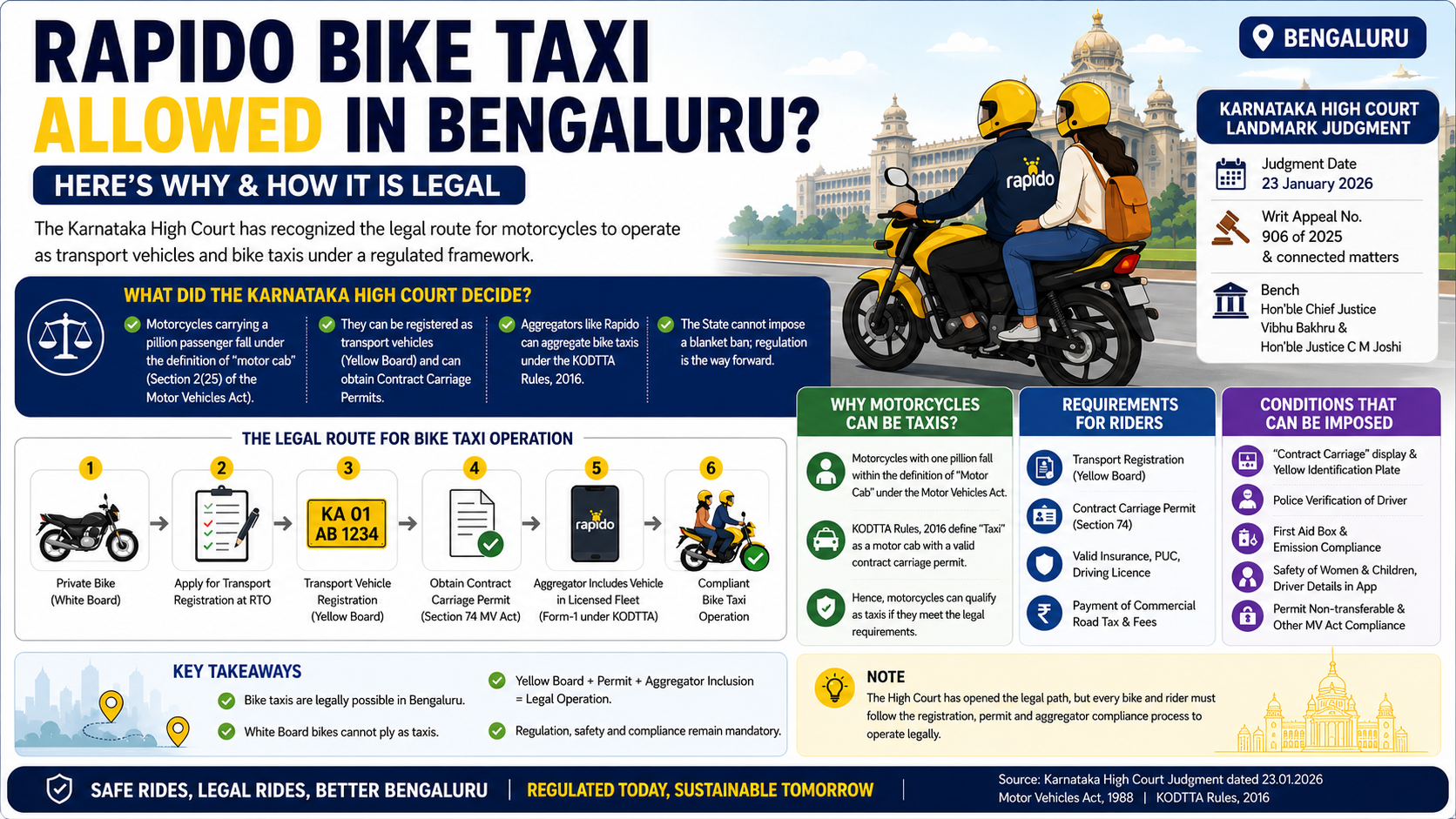
The legal route identified by the Court is:
White Board → Transport Registration/Yellow Board → Contract Carriage Permit → Aggregator Compliance → Vehicle Included in Aggregator Licence → Legal Bike Taxi Operation
That distinction is at the heart of the current Bengaluru bike-taxi story.
1. What exactly did the Karnataka High Court decide?
The central issue before the Division Bench was whether a motorcycle could legally be treated as a transport vehicle and used as a contract carriage or bike taxi.
The Court examined the Motor Vehicles Act, Karnataka’s KODTTA Rules, government notifications, aggregator regulations and the arguments of the State as well as the aggregators and motorcycle owners.
The judgment addressed several connected questions:
- Can a motorcycle be registered as a transport vehicle?
- Can a motorcycle receive a Contract Carriage Permit?
- Can a motorcycle owner operate a bike taxi as a commercial activity?
- Can the State Government impose a blanket prohibition?
- Do the Karnataka aggregator rules cover motorcycle taxis?
- What must aggregators do before putting particular motorcycles on their platforms?
The Court answered these questions in a manner favourable to the legal recognition of bike taxis.
The judgment states that a motorcycle capable of carrying one pillion passenger falls within the statutory concept of a motor cab under Section 2(25) of the Motor Vehicles Act. Consequently, it can fall within the transport-vehicle framework.
2. Why is a motorcycle considered a “Motor Cab”?
This is one of the most important legal points.
Under Section 2(25) of the Motor Vehicles Act, the definition of “motor cab” covers a motor vehicle constructed or adapted to carry a limited number of passengers.
The High Court considered the statutory definitions and concluded that a motorcycle carrying one pillion passenger can fall within the definition of a motor cab.
That finding is critical because the Karnataka On-Demand Transportation Technology Aggregators Rules, 2016 — commonly referred to as KODTTA Rules — define a taxi by reference to a motor cab.
The Court specifically observed that the KODTTA Rules do not restrict the term “taxi” to four-wheelers.
In other words, the rule is based on the legal category of the vehicle rather than simply the number of wheels.
The Court therefore concluded that motorcycles can fall within the definition of taxi under the KODTTA Rules.
3. This is why the High Court ruling is important for Rapido
Rapido was one of the parties involved in the litigation.
The judgment records that Rapido operates as an aggregator of bike-taxi services and had made representations concerning permission to operate as a bike-taxi aggregator in Karnataka.
The State had previously rejected Rapido’s application for permission to operate as an aggregator of bike-taxi services and had advised it to apply under the Electric Bike Taxi Scheme. Rapido’s position was that its services were not restricted to electric motorcycles.
The Division Bench subsequently examined whether the existing KODTTA framework could cover bike taxis.
Its conclusion was significant:
Because motorcycles can fall within the definition of motor cab, and because KODTTA defines a taxi as a motor cab, the aggregator licensing framework cannot simply be interpreted as excluding motorcycles.
The Court specifically held that KODTTA does not exclude bike taxis merely because it does not separately use the word “motorcycle.”
4. But does this mean every Rapido bike can take passengers?
No. This is probably the most important point for Bengaluru passengers and bike-taxi riders.
The High Court made a clear distinction between the legal eligibility of motorcycles to become transport vehicles and the actual operation of individual motorcycles.
The judgment states that the case was not about permitting private white-board motorcycles to operate as taxis.
Instead, the case concerned the right of motorcycle owners to register their motorcycles as transport vehicles — Yellow Board vehicles — and use them as contract carriages.
Therefore:
White Board motorcycle
A private/non-transport motorcycle cannot simply be used for passenger hire merely because the High Court recognized motorcycles as capable of being transport vehicles.
The judgment specifically distinguishes white-board private motorcycles from properly registered yellow-board transport motorcycles.
Yellow Board motorcycle
The motorcycle can be converted/registered as a transport vehicle and can then seek a Contract Carriage Permit under the Motor Vehicles Act.
This is the legally significant pathway established by the judgment.
5. What did the High Court order regarding Yellow Board registration?
The Court’s final directions are extremely important.
Paragraph 149 states that motorcycle owners are at liberty to apply for registration of their motorcycles as transport vehicles (yellow board).
The Court directed the State Government to consider those applications for registration and for permits to operate the motorcycles as contract carriages.
The authorities are allowed to examine relevant issues concerning registration and permits, but they cannot reject an application merely because a motorcycle cannot legally operate as a transport vehicle or contract carriage.
This is the fundamental reason the legal position changed.
Earlier, the argument was essentially:
Motorcycles cannot be used as commercial passenger taxis.
After the Division Bench judgment, that blanket proposition no longer stands.
The correct position is:
A motorcycle can legally enter the transport-vehicle and contract-carriage framework, subject to registration, permit and applicable regulatory conditions.
6. What about the Contract Carriage Permit?
A Yellow Board registration alone is not the complete story.
The motorcycle also needs the appropriate Contract Carriage Permit.
The judgment recognizes motorcycle owners’ entitlement to apply for such permits under Section 74 of the Motor Vehicles Act.
The uploaded RTO application document follows this same legal structure. It seeks:
- conversion from Non-Transport/White Board to Transport Vehicle/Yellow Board;
- determination of applicable commercial road tax and fees;
- re-registration;
- grant of a Contract Carriage Permit under Section 74.
The application also refers to Sections 41, 66, 73, 74 and 80 of the Motor Vehicles Act.
So the basic legal chain is not simply:
Bike + Rapido App = Legal Bike Taxi
It is:
Eligible Motorcycle + Transport Registration + Contract Carriage Permit + Aggregator Compliance = Lawful Bike-Taxi Operation
7. Can the RTO still reject a bike-taxi application?
The High Court did not say that every application must automatically be approved without examination.
Instead, the Court said that the authorities can examine relevant matters concerning registration and permits.
However, they cannot reject an application on the ground that motorcycles cannot be transport vehicles or contract carriages.
The RTO may also impose lawful conditions on the permit under Section 74(2).
Therefore, the judgment does not eliminate regulation.
It changes the nature of the regulation.
The question is no longer:
“Can a motorcycle legally be a taxi?”
The legal framework now allows the answer to be yes, subject to the statutory requirements and permit conditions.
8. What conditions can be imposed on bike taxis?
The High Court judgment discusses possible conditions for motorcycle taxi permits.
Among the conditions referred to in the judgment are:
- “Contract Carriage” to be prominently displayed;
- yellow identification plate;
- police verification of the driver;
- first-aid box;
- compliance with emission standards;
- appropriate standards of comfort and cleanliness;
- adequate parking arrangements;
- passenger access to the driver’s photograph, name and phone number;
- safety responsibilities concerning women and children;
- age-related restrictions for the motorcycle taxi permit;
- non-transferability of the permit;
- compliance with other provisions of the Motor Vehicles Act and applicable rules.
These conditions show that the Court’s approach was not to create an unregulated bike-taxi market. It was to create a regulated legal route for the service.
9. What role does KODTTA 2016 play?
The Karnataka On-Demand Transportation Technology Aggregators Rules, 2016 are central to the entire issue.
The uploaded KODTTA document states that the framework applies to aggregators operating in Karnataka and that an aggregator requires a licence from the Karnataka State Transport Authority. It defines an aggregator as an operator/intermediary that facilitates passenger travel through technologies such as telephone, internet, GPS/GPRS or apps.
The rules define a “Taxi” as a motor cab with the prescribed seating capacity and public-service contract-carriage permit.
The High Court interpreted this definition together with the Motor Vehicles Act and concluded that motorcycles can fall within the motor-cab category.
Therefore, KODTTA is not automatically restricted to four-wheelers.
10. But the aggregator’s licence has another important limitation
This is where many discussions about the Bengaluru bike-taxi issue become confusing.
The High Court did not say that an aggregator can put any motorcycle on its app without informing the authorities.
Paragraphs 141–143 of the judgment make this clear.
An aggregator’s Form 1 application contains the number of taxis proposed to be operated and a separate list containing the vehicle numbers and permit particulars.
The Court found that there is no requirement to submit a completely separate licence application merely because some vehicles are motorcycles.
However, the licence is confined to the vehicles specified in the application/licence.
This means:
Rapido’s general aggregator licence does not automatically make every motorcycle in Bengaluru an authorized Rapido taxi.
The individual vehicle must satisfy the applicable legal requirements and its particulars must be incorporated into the aggregator’s authorized vehicle list.
11. What exactly did Paragraph 147 say?
Paragraph 147 is particularly relevant to the current Rapido discussion.
The High Court held that because the Karnataka Government has KODTTA Rules providing for licences for aggregating taxis, and because taxis include motorcycles, an aggregator is entitled to operate as an aggregator for bike-taxi services.
But there is a condition:
The aggregator must furnish the details of the vehicles for incorporation into its licence.
This is why the vehicle-level compliance issue is so important.
12. Why Form-1 is important
Under KODTTA, the aggregator applies for a licence through Form 1.
The uploaded KODTTA document explains that Form 1 includes the number of proposed taxis and vehicle permit particulars.
The licence is then issued in Form 2.
The High Court also examined these forms and emphasized that the licence is tied to the specified vehicles.
The judgment similarly explains that Form 1 requires the aggregator to provide the vehicle numbers and permit particulars.
Therefore, a compliant bike-taxi ecosystem requires coordination between:
Rider → RTO → Permit → Aggregator → STA/Form-1
This is also why the uploaded representation to aggregators asks companies to establish a dedicated bike-taxi/RTO helpdesk and ensure that converted vehicles are added to the official fleet list submitted to the Karnataka State Transport Authority.
13. Why did the High Court reject the blanket ban argument?
Another major part of the judgment concerns Article 19(1)(g) of the Constitution, which protects the right to carry on a trade, occupation or business, subject to reasonable restrictions.
The Court examined the State’s position that bike taxis should not operate in Bengaluru because of safety, pollution, traffic and other concerns.
But the Court found that a blanket prohibition could not simply rest on an unwritten policy or administrative practice.
The judgment states that a complete ban is a serious restriction and must be supported by credible material and proper legal justification.
The Court concluded that the blanket prohibition on issuing contract-carriage permits to motorcycles could not be treated as a reasonable restriction under Article 19(6) in the circumstances before it.
This is a major legal shift.
The State can regulate bike taxis.
But regulation and prohibition are not the same thing.
Karnataka High Court Order 23rd January 2026
14. What about Bengaluru’s traffic and safety concerns?
This issue was not ignored by the Court.
The judgment records the concerns raised against bike taxis, including traffic, pollution and safety.
The Court also considered an earlier committee report that had expressed negative views about bike taxis in Bengaluru.
However, the existence of such concerns did not automatically give the State an unlimited power to impose a blanket prohibition without a proper statutory basis and adequate justification.
The Court therefore adopted a regulatory approach rather than accepting an absolute prohibition.
15. Why is this different from the white-board bike-taxi controversy?
This distinction is crucial.
A white-board motorcycle is registered as a private/non-transport vehicle.
Using such a vehicle for carrying passengers for hire can create a registration and permit problem.
The High Court itself expressly distinguished the present case from the situation involving white-board motorcycles being used as taxis.
The judgment notes that the present case concerns motorcycle owners seeking yellow-board transport registration and Contract Carriage Permits.
Therefore, anyone reading the judgment should not interpret it as:
“White-board bike taxis are automatically legal in Bengaluru.”
That is not what the judgment says.
16. What should a bike-taxi rider do?
Based on the legal roadmap reflected in the judgment and the uploaded documents, a motorcycle owner seeking to operate legally would generally need to follow the regulatory route.
Step 1: Apply for transport registration
The rider can apply to the RTO/RTA for conversion of the private motorcycle into a transport vehicle.
The uploaded application specifically seeks conversion from White Board to Yellow Board.
Step 2: Determine and pay applicable taxes and fees
The proposed application asks the RTO to determine the applicable commercial road tax, permit fee and re-registration charges.
This is important because the uploaded document itself notes the need for clarity from the RTO on the exact applicable fee structure.
Step 3: Obtain the Contract Carriage Permit
The motorcycle needs the appropriate permit under Section 74.
Step 4: Complete vehicle compliance
Insurance, PUC, licence and other statutory documents need to be maintained.
Step 5: Aggregator inclusion
After the motorcycle obtains the required transport registration and permit, the aggregator should include the vehicle particulars in its authorized fleet/list.
Step 6: Passenger-facing compliance
The aggregator and vehicle should comply with applicable driver identification, safety, display and app-profile requirements.
The uploaded aggregator representation specifically asks companies to display verified driver and vehicle permit credentials in the app.
17. What does this mean for Rapido passengers in Bengaluru?
For passengers, the key question should not simply be:
“Is Rapido legal?”
The more precise question is:
“Is this particular bike taxi and its rider operating under the required transport registration, permit and aggregator framework?”
The High Court has recognized the legal possibility of motorcycle taxis and the right of aggregators to aggregate them.
But individual vehicle compliance remains important.
The judgment specifically says the aggregator’s licence must be confined to the taxis specified in the relevant application/licence.
Therefore, the legal status of a bike taxi ultimately involves both:
Platform-level compliance + vehicle-level compliance.
18. What did the Court order regarding existing aggregator applications?
The final directions also address the aggregators themselves.
Paragraph 151 states that the concerned authorities should consider pending aggregator applications and pass appropriate orders.
Aggregators are also at liberty to submit fresh licence applications, which must be considered in accordance with law and the observations in the judgment.
This is significant for Rapido, Ola and other platforms because the judgment did not merely discuss theoretical rights.
It created a legal pathway for the regulatory authorities to process applications.
19. Why can Rapido potentially take bike-taxi rides now?
The answer can be summarized in five points.
Reason 1: Motorcycles can qualify as motor cabs
The High Court interpreted the Motor Vehicles Act and held that motorcycles carrying a pillion passenger can fall within the motor-cab definition.
Reason 2: Motorcycles can be transport vehicles
The Court recognized the legal route for registering motorcycles as transport vehicles.
Reason 3: Contract Carriage Permits can be issued
Motorcycle owners can apply for permits under Section 74.
Reason 4: KODTTA covers taxis, and motorcycles can qualify as taxis
The Court rejected the argument that KODTTA is inherently limited to four-wheelers.
Reason 5: Aggregators can aggregate bike taxis
The Court held that aggregators can operate bike-taxi services, provided the relevant vehicles are included in their licence/vehicle particulars.
20. The most important warning for riders
There is a huge difference between:
“Bike taxis are legally recognized.”
and
“Any bike can immediately operate as a taxi.”
The first statement is supported by the judgment.
The second is not.
A rider cannot simply take a private white-board motorcycle, register on an app and assume that the High Court judgment automatically converts that vehicle into a commercial taxi.
The proper legal route involves registration, permit and aggregator compliance.
The proposed RTO application itself is structured around exactly this process: re-registration from Non-Transport to Transport Vehicle, determination of applicable taxes/fees and issuance of a Contract Carriage Permit.
21. Why this judgment is a big development for Bengaluru’s mobility system
Bengaluru has a major last-mile connectivity challenge.
Bike taxis offer a different mobility model from conventional autorickshaws and cars.
They can potentially provide:
- faster short-distance travel;
- last-mile connectivity;
- connectivity to Metro stations;
- lower vehicle footprint than cars;
- an additional earning opportunity for motorcycle owners;
- app-based booking and tracking.
But the legal framework now needs to catch up with the practical reality.
The High Court’s judgment essentially says that the solution cannot simply be an unwritten prohibition.
If the State has safety, traffic, pollution or passenger-protection concerns, those concerns can be addressed through lawful conditions and regulation.
The Court expressly allowed the Regional Transport Authority to impose lawful permit conditions.
22. What is the role of the RTO now?
The RTO becomes one of the most important institutions in the bike-taxi transition.
The uploaded documents propose a practical process in which the RTO:
- receives the application;
- verifies the motorcycle;
- determines applicable commercial tax;
- determines permit and re-registration charges;
- completes transport registration;
- grants the Contract Carriage Permit if statutory requirements are met;
- records the relevant vehicle particulars.
The proposed RTO application even contains an office-use section for vehicle inspection, commercial tax determination, permit fee and re-registration charges.
23. What is the role of Rapido and other aggregators?
The High Court ruling places an important compliance responsibility on aggregators.
They cannot simply say:
“We have an aggregator licence, therefore every bike is covered.”
The Court specifically held that the licence is confined to the taxis specified in the licence and that the vehicle details must be furnished.
This means platforms need a proper system for:
- collecting vehicle permit information;
- verifying documents;
- updating fleet records;
- incorporating eligible motorcycles into the relevant licence;
- maintaining driver information;
- ensuring app-level compliance.
The uploaded representation to aggregators therefore proposes a dedicated Bike Taxi Legal & RTO Helpdesk to assist riders with conversion, tax calculation, permits and documentation.
24. So, is bike taxi legal in Bengaluru in 2026?
The safest answer based specifically on the uploaded High Court judgment is:
Yes, the Karnataka High Court has recognized the legal route for motorcycles to operate as transport vehicles and contract carriages, and it has held that aggregators can aggregate bike taxis under the applicable framework.
But:
No, this does not mean that every white-board private motorcycle can automatically carry passengers for hire.
The vehicle needs to follow the transport-registration and permit framework, and the aggregator must comply with the licensing and vehicle-list requirements.
This distinction is essential for both riders and passengers.
25. The Bengaluru bike-taxi situation in one simple flow
Earlier position
White Board Bike
↓
Government/administrative uncertainty
↓
Aggregator permission dispute
↓
Bike-taxi operations challenged
After Karnataka High Court judgment dated 23 January 2026
Motorcycle
↓
Can be considered for Transport Vehicle registration
↓
Yellow Board
↓
Contract Carriage Permit under Section 74
↓
Vehicle details furnished to aggregator/STA
↓
Vehicle included within aggregator’s licensed fleet
↓
Compliant Bike Taxi Service
This is the legal framework that emerges from the judgment.
26. Final Verdict: Why is Rapido Bike Taxi Allowed to Take Rides in Bengaluru?
The reason is not simply that Rapido has an app.
It is not because the Government has given every private motorcycle permission to carry passengers.
And it is not because a white-board motorcycle automatically becomes a taxi.
The real reason is the January 23, 2026 Karnataka High Court Division Bench judgment, which recognized that motorcycles can fall within the statutory framework of motor cabs and transport vehicles, that motorcycle owners can seek Yellow Board registration and Contract Carriage Permits, and that aggregators can aggregate bike taxis under the KODTTA framework.
At the same time, the Court made vehicle-level compliance important: the relevant motorcycles and their permit particulars have to be incorporated into the aggregator’s licensed vehicle framework.
The Court’s final directions are particularly clear: motorcycle owners are free to apply for Yellow Board registration and permits; the State must consider those applications; lawful permit conditions can be imposed; and pending or fresh aggregator applications must be considered according to law.
Therefore, the simplest answer is:
Bike taxis are legally possible in Bengaluru because the Karnataka High Court has recognized motorcycles as capable of being transport vehicles and contract carriages and has rejected a blanket prohibition that prevents their registration and permitting merely because they are motorcycles.
But the legal green light comes with a compliance route:
Yellow Board + Contract Carriage Permit + Aggregator Licence/Fleet Inclusion + Applicable Safety & Regulatory Conditions.
That is the real story behind the latest Rapido News Today Bangalore and Bengaluru bike-taxi controversy.