
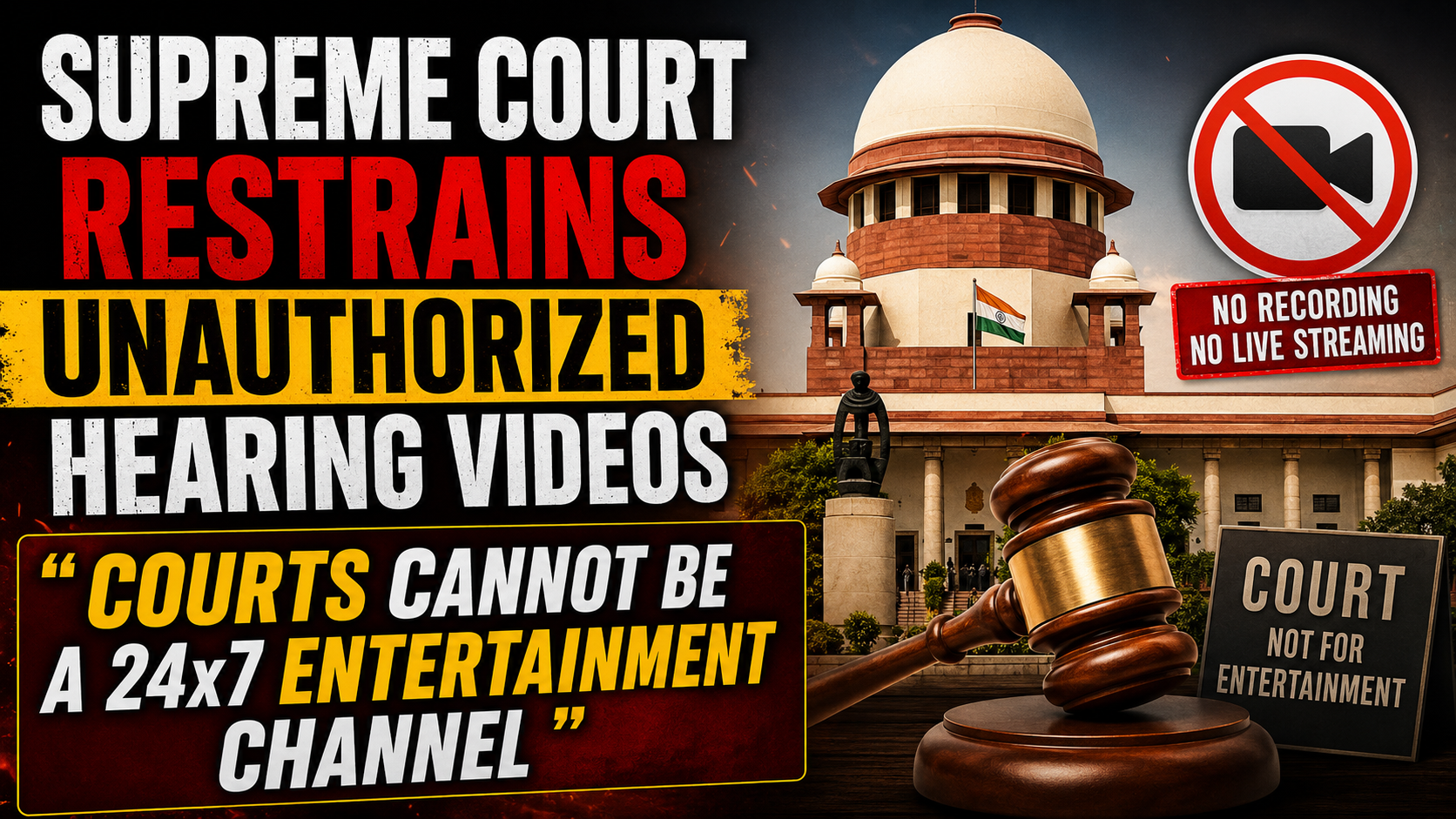
Safeguarding the Sanctuary of Justice: Unpacking the Supreme Court’s Ban on Unauthorized Courtroom Videos
In a watershed directive aimed at preserving the solemnity of the judicial process, the Supreme Court of India passed a sweeping interim order restraining the extraction, modification, dissemination, posting, reposting, uploading, or monetization of audio and video recordings of court proceedings across social media and digital platforms without explicit prior permission.
The order—handed down by a Bench comprising Chief Justice of India Surya Kant, Justice Joymalya Bagchi, and Justice V. Mohana—marks a critical juncture in India’s experiment with judicial transparency. While open justice and public access remain bedrock principles of democratic governance, the court’s sharp critique highlighted a growing digital malaise: the transformation of serious legal proceedings into clickbait, sensationalized shorts, and viral memes.
As Justice Joymalya Bagchi strikingly observed during the hearing, “Courts cannot be a 24×7 entertainment channel.”
The Anatomy of the Interim Order
The directive arose from a Public Interest Litigation (PIL) filed by journalist Harshita Grover, represented by Senior Advocate Vikas Singh. The petition challenged the rampant, unregulated clipping, editing, and commercialization of live-streamed courtroom recordings on platforms like YouTube, X (formerly Twitter), Instagram, and Meta.
The apex court’s order lays down a strict regulatory mandate:
- Mandatory Prior Authorization: No person or entity may extract, alter, upload, repost, share, or monetize audio-video recordings of judicial proceedings without written permission from the Secretary General of the Supreme Court or the Registrar General of the jurisdictional High Court.
- Protection for News Reporting: The Bench explicitly clarified that the restriction is not a gag order and does not impinge upon fair, objective, and accurate journalistic reporting of court proceedings.
- Broad Digital Scope: The court issued notices to social media giants, including Meta Platforms and X, alongside the Union Government and all High Courts, signaling a structural push toward a enforceable national framework.
The Apex Court’s Rule:
“There shall be no extraction, modification, dissemination, posting, re-posting, uploading or monetisation of audio/video recordings of the judicial proceedings on social media or other digital platforms without the prior permission of the Registrar General of the concerned High Courts or the Secretary General of the Supreme Court.”
From Sunshine Laws to Social Media Sensationalism
To understand how Indian jurisprudence arrived at this crossroad, one must trace the evolution of courtroom live-streaming in the country.
1. The Promise of Swapnil Tripathi (2018)
In the landmark judgment Swapnil Tripathi v. Supreme Court of India (2018), a three-judge Bench championed live-streaming as an expansion of the right to access justice under Article 21 and freedom of information under Article 19(1)(a). The rationale was clear: sunlight is the best disinfectant. Live streaming was intended to educate the public, democratize legal knowledge, demystify courtroom procedure, and bring accountability to the bench and bar.
2. The Model Rules and Reality Gap
When live-streaming gained full momentum around 2022, the Supreme Court introduced the Model Rules for Live-Streaming and Recording of Court Proceedings. These rules clearly stated that copyright over courtroom recordings remains exclusively with the judiciary, prohibiting unauthorized re-sharing or alteration.
However, as live feeds spread across High Courts (such as Gujarat, Karnataka, and Madhya Pradesh) and the Supreme Court, internet algorithms quickly capitalized on the content.
3. The Digital Distortion
Over the last few years, social media channels began treating courtroom exchanges not as legal discourse, but as performative content. Key issues emerged:
- Decontextualized Snippets: A 15-second clip of a judge making a preliminary observation or testing an advocate’s hypothesis was stripped of its legal context and packaged as a “furious judge destroys lawyer” video.
- Algorithmic Sensationalism: Content creators added dramatic background scores, sensational titles, and misleading thumbnails to maximize engagement and ad revenue.
- Deepfakes & AI Manipulation: As Solicitor General Tushar Mehta pointed out during the proceedings, emerging generative AI tools make it effortless to alter voice recordings and lip movements, posing a direct threat of judicial impersonation and disinformation.
- Harassment of Litigants and Counsel: Trolling, public vilification, and meme culture began targeting lawyers, judges, and vulnerable parties based on out-of-context clips.
The Impact on Educational and Awareness Channels
One of the most immediate points of confusion surrounding the order is whether unaltered, complete, or purely educational uploads are exempt.
The simple answer is no. The interim order creates a strict blanket gatekeeping mechanism.
| Purpose | Status Under Interim Order | Requirement |
| Monetized Content / Shorts | 🚫 Strictly Prohibited | N/A (Violation of copyright & court order) |
| Edited / Clipped Videos | 🚫 Strictly Prohibited | N/A |
| Educational / Academic Uploads | ⚠️ Restricted | Requires prior written approval from Secretary General / Registrar General |
| Textual / Broadcast News Reporting | ✅ Permitted | Must remain fair, accurate, and objective |
While educators, legal researchers, and law students often utilize raw courtroom video to demonstrate trial strategy, cross-examination techniques, or constitutional debates, the court’s order makes no automatic exception for good intentions. Because content shared under the banner of “awareness” can still be weaponized or circulated without proper context, the court chose a unified permission-first standard.
Striking a Balance: Transparency vs. Institutional Integrity
The debate sparked by the Supreme Court’s direction reflects a global challenge faced by judiciaries navigating the digital age.
The Risk of Digital Mob Mentality
Judicial proceedings are deliberate, technical, and grounded in procedural law. A judge playing devil’s advocate during oral arguments does not reflect a final verdict. However, in the court of public opinion hosted on short-form video platforms, nuanced legal debate is frequently misconstrued as bias or hostility.
As Justice Bagchi remarked, once unguided data enters the digital ecosystem, it becomes a “demon out of the bag” that is nearly impossible to recall.
Protecting Open Justice
At the same to time, freedom of speech advocate Justice V. Mohana emphasized that the ruling must not be seen as a retreat from transparency or an abridgment of fundamental rights. The goal is not to hide courtrooms behind closed doors, but to insulate the dignity of the judicial process from commercialization and distortion.
The Path Ahead
The Supreme Court has asked the Union Government to identify nodal ministries capable of enforcing these restrictions digitally, while directing all High Courts to submit comprehensive reports on the operational impact and feasibility of continuous live-streaming.
As the matter progresses, the court will likely formulate a permanent framework. This may include:
- Official Centralized Repositories: Archiving full, unedited hearings on court-controlled portals rather than commercial video platforms.
- Clear Licensing Mechanisms: Defining clear application workflows for academic institutions and legal educators to license footage for non-commercial study.
- Watermarking & Digital Rights Management (DRM): Deploying technology to prevent unauthorized clipping and screen recording.
The judiciary’s message is clear: transparency will not be sacrificed, but it will not come at the cost of turning the hall of justice into a content factory. Access to the courtroom remains a public right, but respect for its process remains an absolute duty.