
What is TG RERA and Why Every Property Buyer Must Check
Published by Farhan Rasheed — A True Guide & Real Estate Research Advisor • 18 Nov 2026
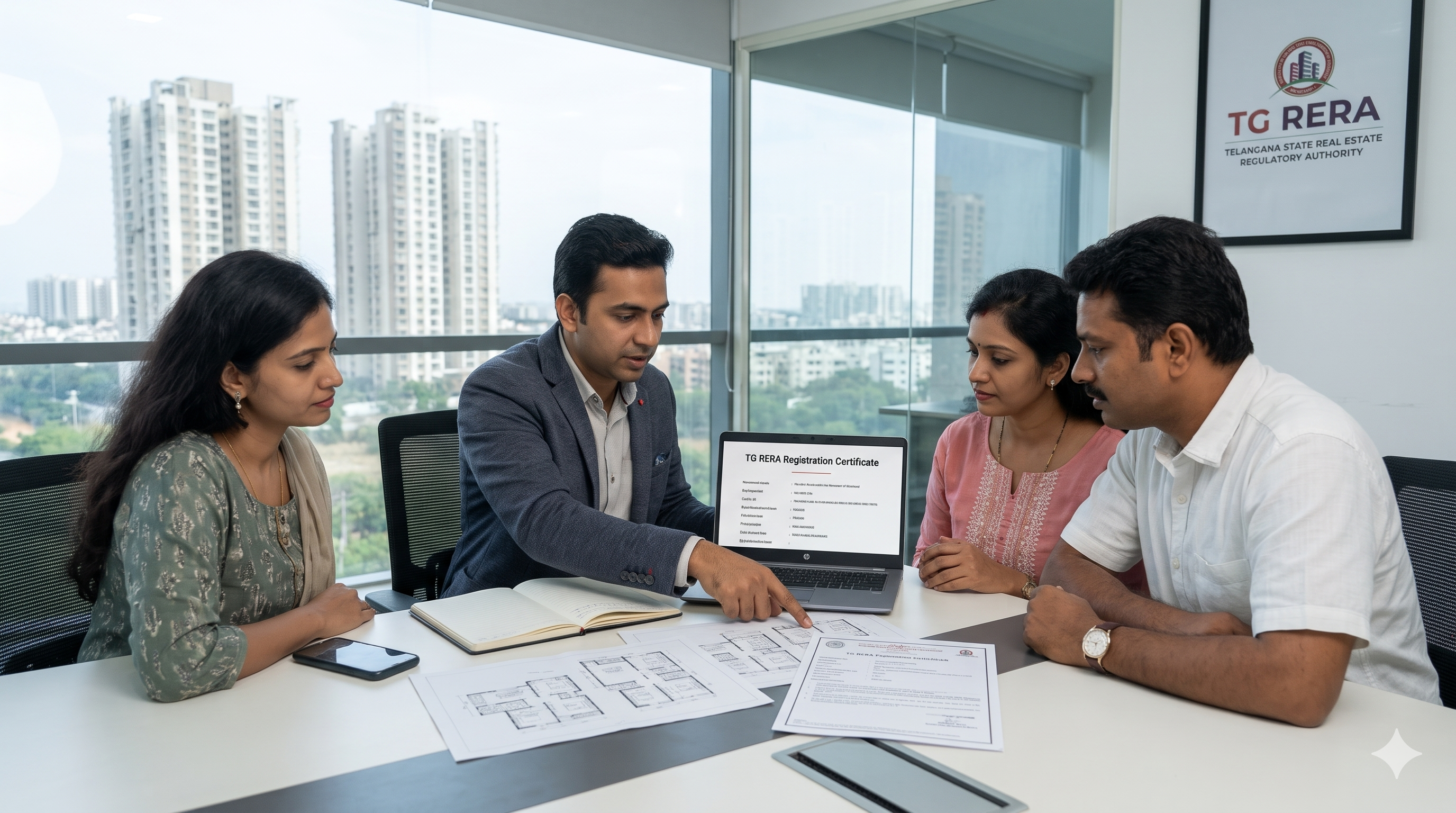
By Farhan Rasheed — A True Guide & Real Estate Research Advisor, Hyderabad
Buying a home or investing in a residential plot is one of the largest financial commitments a family will ever make. Yet, across Hyderabad and Telangana’s rapidly expanding growth corridors—from Kokapet and Tellapur in the West to Adibatla, Ibrahimpatnam, Kandukur, and Uppal in the South and East—thousands of buyers still sign booking forms based purely on glossy brochures, verbal promises from sales executives, or attractive pre-launch discounts.
Before transferring a single rupee as a token advance, there is one non-negotiable verification every property buyer must complete: checking the project on the Telangana State Real Estate Regulatory Authority (TG RERA) portal (rera.telangana.gov.in).
What is TG RERA?
TG RERA (formerly referred to as TS RERA) is the statutory regulatory authority established by the Government of Telangana under the central Real Estate (Regulation and Development) Act, 2016 and the Telangana Real Estate (Regulation and Development) Rules, 2017. Its core mandate is to enforce transparency, financial discipline, and legal accountability across Telangana’s real estate sector while providing homebuyers with a dedicated, fast-track dispute resolution mechanism.
Under TG RERA rules, mandatory project registration applies to any residential, commercial, or plotted real estate project where:
- The land area proposed for development exceeds 500 square meters (approx. 598 square yards), OR
- The number of apartments/units proposed across all phases exceeds eight (8)—even if the plot size is smaller than 500 sq. meters.
Furthermore, no promoter or real estate agent can legally advertise, market, book, sell, or invite people to purchase any unit in a covered project without first obtaining a valid TG RERA registration number and displaying it prominently in the top-right corner of every advertisement.
6 Reasons Why Every Property Buyer Must Verify TG RERA Before Booking
1. Proof of Prior Statutory Approvals
A developer cannot simply apply for TG RERA registration with raw agricultural land. Before granting a Form 'C' Registration Certificate, TG RERA requires the promoter to upload approved layout or building permissions from the competent authority—such as HMDA (Hyderabad Metropolitan Development Authority), GHMC (Greater Hyderabad Municipal Corporation), DTCP (Directorate of Town and Country Planning), or local municipalities—alongside land title documents, Encumbrance Certificates (EC), and NALA conversion orders. An active TG RERA number confirms the project has passed baseline statutory scrutiny.
2. 70% Escrow Account Protection Against Fund Diversion
Historically, the biggest cause of stalled apartment projects in Hyderabad was builders diverting money collected from one project to buy new land elsewhere. Under Section 4(2)(l)(D) of the Act, every TG RERA-registered promoter must deposit 70% of all funds collected from homebuyers into a separate, dedicated bank escrow account. Money can only be withdrawn in proportion to verified construction progress, certified jointly by an engineer, an architect, and a chartered accountant.
3. Standardized "Carpet Area" Pricing
Before RERA, buyers frequently paid for inflated "Super Built-Up Area" where loading factors of 30% to 45% meant paying for lobbies, staircases, and shafts while getting far less usable space inside the home. Under TG RERA, promoters must quote and sell apartments strictly on Carpet Area—the actual usable floor area within the internal walls of the flat.
4. The 10% Advance Cap Before Registered Agreement
Under Section 13(1) of the RERA Act, a developer cannot demand or accept more than 10% of the total property cost as an advance or application fee without first executing and registering a written Agreement for Sale in the government-prescribed format. If a sales team pressures you to pay 20% or 30% upfront on a simple allotment letter without registration, treat it as an immediate red flag.
Have Questions About This Report?
Connect directly with Farhan Rasheed for property & RERA advisory.
Ask on WhatsApp
Have Questions About This Report?
Connect directly with Farhan Rasheed for property & RERA advisory.